
 Rights of Indigenous Peoples
 Indian Act
 Know Your Rights
 Criminal Law
 Child Protection
 Fair Decision Making
The type of jail sentence you receive affects where you will serve your sentence.
If you receive a conditional sentence, you will serve it in the community under a Conditional Sentence Order. Otherwise, if your sentence is for less than 2 years, you will serve it at a provincial correctional facility. If you receive a sentence of more than 2 years, you will serve it at a federal facility. If you have serious mental health concerns, you may serve your sentence or part of it at a secure hospital facility where you can receive psychiatric treatment.
Conditional Sentence
A conditional sentence is a jail sentence that you serve in your community under conditions rather than in a jail. The judge will make a Conditional Sentence Order (CSO) listing the conditions you must follow. You will be given a copy of the CSO. Make sure you understand all of the conditions and ask questions if you do not.
You will be required to report to a supervisor and the CSO will list the address and phone number for that supervisor. You usually need to report to the supervisor within two working days of receiving the sentence (or within two working days of being released from custody if you are in custody). The CSO will also say where you need to live and when you can be outside of your home (your curfew). You may have a condition requiring your location to be monitored electronically. In that case, you will need to receive the electronic monitoring device before you are released from custody. Other conditions may include things like:
- not going to certain locations in your community or not leaving your community at all
- not having any alcohol, drugs or weapons
- having to submit to breath tests or searches
- having to attend a treatment program or other programming
- having to complete community service hours or pay restitution
- having no contact with certain people
Your supervisor may be able to make small changes to your conditions in some circumstances, such as allowing you to leave your home to attend an appointment, but you must have their permission beforehand or you may be charged with a breach and risk serving the rest of your sentence in jail.
More significant or longer-term changes can be made to the CSO but they require an application to a judge at Provincial Court. Whoever is requesting the change (you, your supervisor or the Prosecutor) must file an application saying what they want to change and why. If you are the one applying, you have to make sure your supervisor and the Prosecutor know that you are applying. Your supervisor has to say on the application form whether they agree with the request or not. A judge will decide whether to make the change or not.
Sentence of Less Than Two Years
Who Decides?
A judge decides your sentence and can make a recommendation about where you serve it. But the actual decision about which facility you will be in is made by staff at Correctional Service Canada (sentences 2 years or more) or the provincial Ministry of Community Safety (sentences less than 2 years).
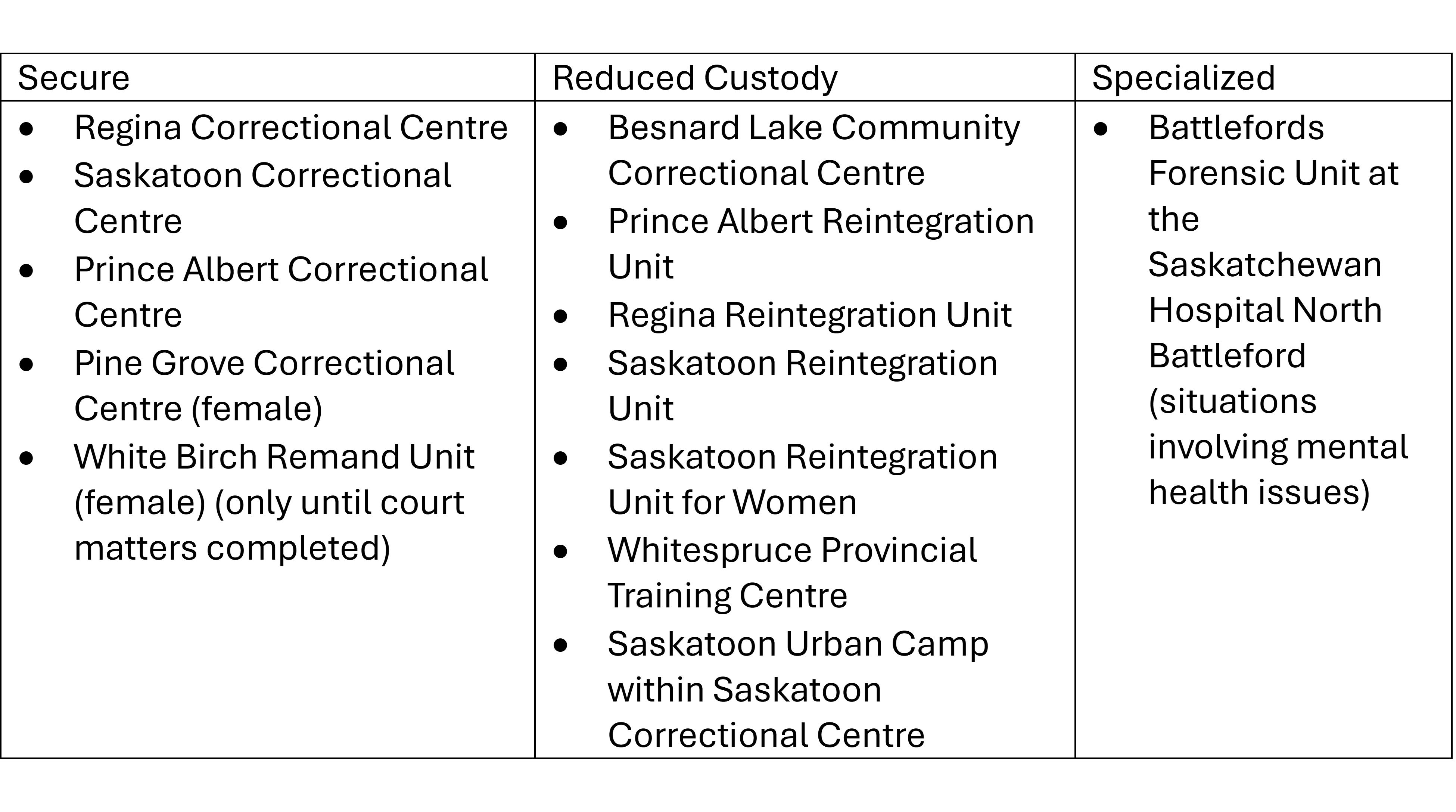
If your jail sentence is for less than two years, you will serve it in a provincial correctional facility. These places are run by the provincial government's Ministry of Community Safety and are divided into "secure" and "reduced custody" facilities. You will usually start off in a secure facility but may be able to transfer to a reduced custody facility later. Many reduced custody programs are only available after you have served a certain amount of your sentence. You are not eligible for some reduced custody programs if you are serving a sentence for certain offences, if you have other outstanding charges or if you have been recently convicted of certain offences.
The correctional facilities in Saskatchewan are listed below:
You will usually serve your sentence at the correctional facility nearest to the court where you were sentenced but you can ask to serve it elsewhere. For example, you might ask to serve your sentence at a place closer to your home community or at a reduced custody facility that may provide greater opportunity to reintegrate back into your community. You can make this request...
- As a part of sentencing, you or your lawyer can ask the judge to make a recommendation about where you will serve your sentence. The judge may or may not do this and recommendation may or may not be followed by corrections staff, depending on your safety and risk assessment.
- After sentencing and after you've been admitted to a facility, you can ask for a transfer to another facility.
There are fewer options for women who are sentenced to provincial jail time. Pine Grove Correctional Centre is currently the only women's facility in the province. The Saskatoon Reintegration Unit for Women is the only reduced custody option.
When you enter a provincial correctional facility, you will be assigned to a case manager and will have two assessments:
- a security assessment to help determine the level of security required for your time in jail
- a risk assessment to help determine your risk to re-offend, to figure out what programs will be helpful to you and what help you might need when you leave the facility (return to your community)
Your case manager should help you to find appropriate programs within the facility during your sentence and help you with reintegration (return to your community) plans and options at the end of your sentence.
Sentence of Two Years or More
If you are given a jail sentence of two years or more, you will serve your sentence at a federal facility run by Correctional Services Canada. Like provincial facilities, you will have an assessment and be assigned a security level when you first enter the facility.
The Saskatchewan Penitentiary is the only federal facility in the province that has all levels of security (maximum, medium, minimum). It is for men only. If you are a woman and do not qualify for a healing lodge, you will likely serve your federal sentence at a regional facility outside of Saskatchewan.
There are three federal healing lodges in the province - Willow Cree Healing Centre, Okimaw Ohci Healing Lodge (women) and Prince Albert Grand Council Spiritual Healing Lodge. The lodges emphasize Indigenous values, traditions and beliefs. You may be able to serve your entire sentence at a healing lodge or you may request a transfer to a lodge after serving part of your sentence.
In a federal facility, you will have a case management team. This team should include an Elder. The team will help you access programming that is helpful to you while you are in jail and will help you with reintegration back into your community at the end of your sentence.
Are There Cultural Programs Available in Jail?
First Nations and Métis cultural programming should be available in both provincial and federal institutions. Programs can include access to cultural centres or lodges with opportunities for sweat lodges, pipe ceremonies, counselling with an Elder, smudging, traditional feasts and traditional teachings. There may by culturally supportive programs that help you return to your community through training, employment or education. Programming is often led by Indigenous people and may be offered in partnership with a Tribal Council, First Nation, Métis Nation-Saskatchewan or other Indigenous governing body or organization.
You can ask your case manager or anyone on your case management team to help you access these types of programs in whatever facility you serve your sentence in.