 Rights of Indigenous Peoples
 Indian Act
 Know Your Rights
 Criminal Law
 Child Protection
 Fair Decision Making
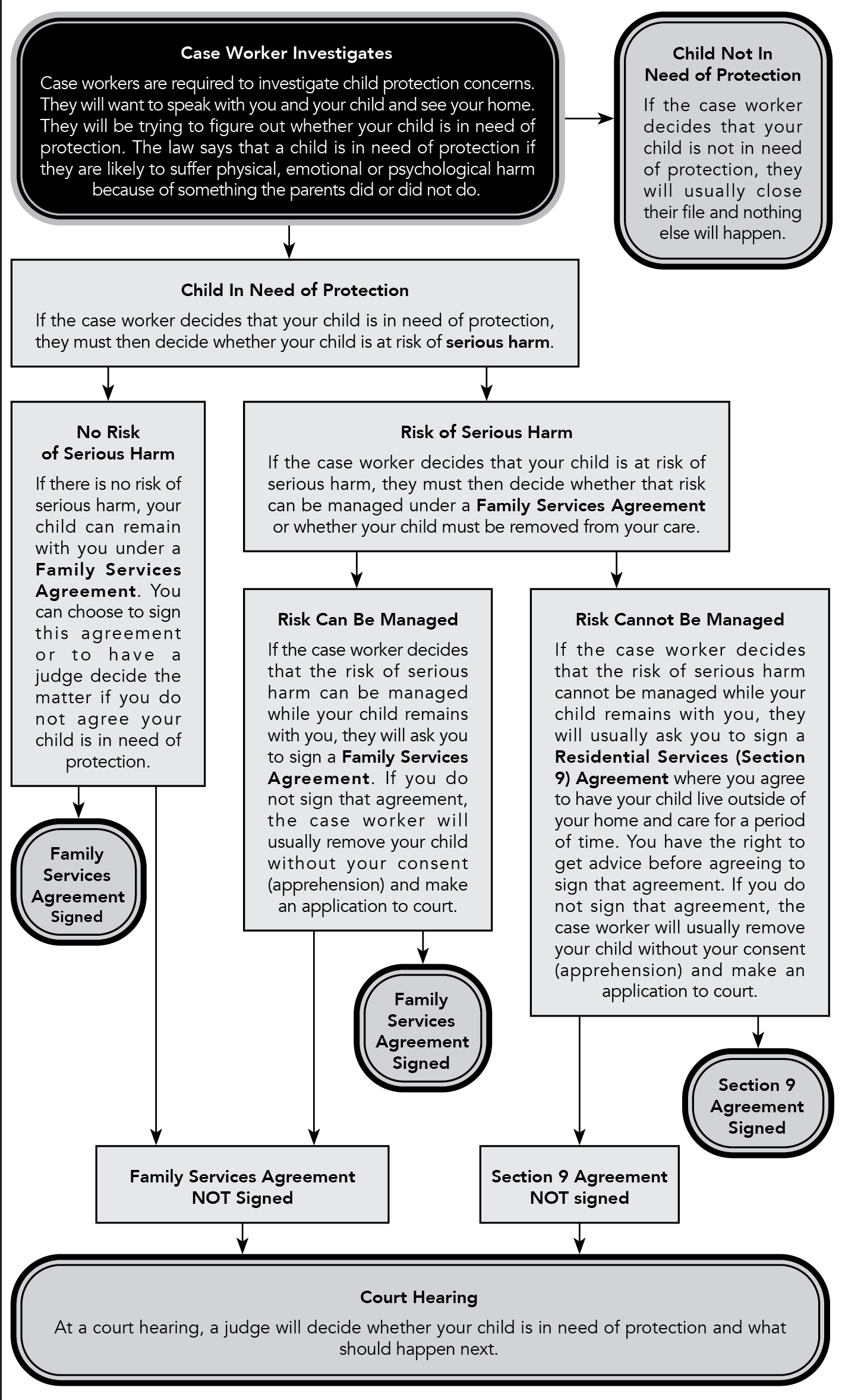
The chart below shows the process from an initial contact with a case worker up to the possibility of a court hearing. Below the chart we provide details on each stage and highlight some things to remember.
Process Chart
A case worker may represent either the Ministry of Social Services or an FNCFS Agency. A case worker is usually responding to a report they received from someone who is concerned about your child. They may also have received a referral from court under the Youth Criminal Justice Act. Although they will not share the name of the person who made the report, they must tell you what the report said and why they think an investigation is necessary.
Case workers are required to investigate reports that a child may be in need of protection. This does not mean anything will happen but it means that the case worker will want to speak with you, your child and possibly others involved in your child's life and will want to see your home. They will be trying to figure out whether your child is at risk of harm right away or in the future.
You can explain what you are doing to keep your child safe, why you feel your child is safe in your home and what you can do to continue to keep them safe.
Important Things to Know About an Investigation...
- A case worker will usually contact you before they come to your home but they can to your home without warning if they think it is necessary. They may do this if they are unable to reach you or if, for example, they think that someone who is a safety risk to your child will leave the home if they the case worker is coming.
- A case worker can speak to your child outside of your home and without you present but they should tell you in advance they're doing to do this, unless they think that telling you will put the child's safety at risk. If they want to speak to your child without you, you can ask to have someone you and your child trust present when they do that. This request may or may not be granted.
- If a case worker is concerned about physical abuse or neglect, they may ask you to agree to have your child examined by a doctor. If you do not agree, they can apply for authority under the law (a "Warrant Access to Child") to take your child for an examination. This is not an apprehension and only for the purpose of the examination. They can also ask for this if you refuse to let a case worker see your child.
- Every time a decision is being made about your child, the case worker should let you know that your can appeal a decision if you do not agree and how to do that.
- If, after the case worker's initial visit, they are concerned that your child may be at risk without certain plans in place, they may ask you to sign a Safety Plan until the end of the investigation. If the case worker is concerned about your child's safety, a Safety Plan may allow you to address the case worker's concerns and have your child stay with you while they investigate. If you refuse to sign a safety plan, the case worker may decide to apprehend your child.
Remember To...
- ask for the case worker's name and business care so that you know who you are talking to and contact them later
- write down what the case worker told you as soon as you can so that you have a record
- prepare for any further meetings with the case worker by keeping track of how you are keeping your child safe and by gathering any relevant documents or other records
- contact Legal Aid (or another lawyer) who can explain the process to you, make sure the Ministry or FNCFS Agency is treating you and your child fairly and speak to the Ministry or Agency on your behalf.
At the end of an investigation, the case worker will make a decision...
A case worker may decide that your child is not in need of protection. In this case, they will close their file and nothing more will happen. The case worker may meet with you again and talk to you about other supports you might want to access.
OR
A case worker may decide that your child is in need of protection. In this case, they will give you a "Letter of Notification of Child in Need of Protection" and will also notify any applicable FNCFS Agency or Indigenous governing body such as your First Nation or Métis Nation-Saskatchewan. They must also offer you family services. They will want to have a meeting with you to talk about the investigation and the next steps, including an agreement to receive family services. They may ask you to sign a Family Services Agreement at this stage. If you signed a Safety Plan during the investigation, a Family Services agreement may have many of the same terms. If you do not sign an agreement, the case worker may make a court application to have a judge decide whether your child is in need of protection and what should happen next.
OR
A case worker may decide that your child is in need of protection and that they are at risk of serious harm and that the risks cannot be managed while your child is with you. In this case, they may ask you to sign a Residential Services (Section 9) Agreement to have your child live elsewhere for a certain amount of time. If you refuse they may remove your child from your home without your agreement (apprehension) and must then make a court application to have the court decide whether your child is at risk of serious harm and what should happen next.
We have more information on all types of agreements under Agreements and Can My Child Be Removed From My Care and My Home.
Legal Advice
It is a good idea to get legal advice as soon as possible to make sure you understand your rights and have someone who can advocate on your behalf. See our information on getting a lawyer under When Should I Get a Lawyer.