 Rights of Indigenous Peoples
 Indian Act
 Know Your Rights
 Criminal Law
 Child Protection
 Fair Decision Making
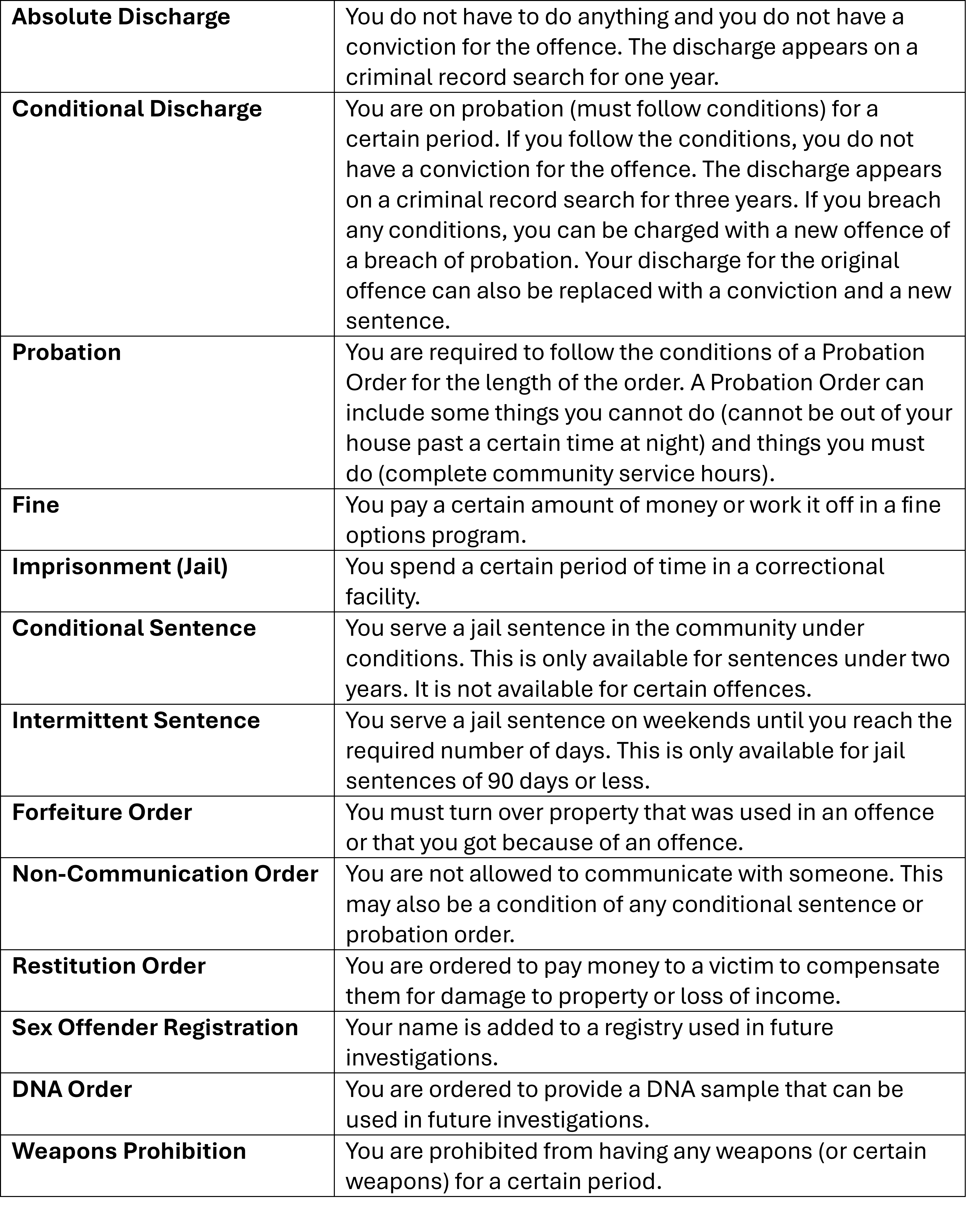
The chart below summarizes the types of sentences possible for criminal offences. Further descriptions of each are given at the bottom of the page.
Victim Surcharge
A victim surcharge is a set amount that you are ordered to pay for every offence. The money is used to fund services for victims. If a sentence already includes a fine, the surcharge amount is 30% of that fine. Otherwise, the surcharge is $100 for less serious offences and $200 for more serious offences. However, judges can choose not to make you pay the surcharge if they think it would cause undue hardship or where they feel it is unnecessary for very minor offences.
Absolute or Conditional Discharge
Receiving a discharge means you will not have a conviction for the offence on your criminal record. A judge cannot order a fine if they give you a discharge.
If you are given an absolute discharge, that's it. You are free to go. The discharge will appear on your criminal record for one year.
If you are given a conditional discharge, the judge will make a probation order (up to 3 years) and you will have to follow the conditions in that order under the supervision of a probation officer. If you follow those conditions, you will not have a conviction for that offence on your criminal record. The discharge will appear on your criminal record for three years. If you do not follow the conditions, you can be charged with breaching the probation order. In addition to a sentence for the breach, a judge can change the conditions or give you an entirely different sentence with no chance of a discharge.
Suspended Sentence with Probation
A suspended sentence means that sentencing is delayed. The judge makes a probation order (up to three years) containing conditions you must follow. Conditions will include things you cannot do and may include things that you must do (like community service hours). While on probation, you are supervised by a probation officer. Unlike a conditional discharge, you will have a conviction on your criminal record for the offence. But like a discharge, a judge cannot order a fine on top of a suspended sentence.
If you do not follow the conditions of your probation order, you can be charged with a breach. If guilty, you can be sentenced for that breach and be required to serve whatever sentence would have been appropriate for the original offence (i.e. your probation could be terminated and you could receive a jail sentence instead).
Fine
You may be sentenced to pay a fine. Unless the offence you are charged with has a minimum fine, a judge can only impose a fine if they think you will be able to pay it or work it off in a fine options program. If you do not pay the fine, the federal or provincial government can suspend any licences and permits you hold or can refuse to issue new ones that you may apply for. They can also take money off of wages you earn at your job. If these options don't work, you can be sent to jail for failing to pay the fine.
Jail
If you are given a jail sentence, the length of that sentence depends on the offence you are convicted of. There is always a maximum length that can be given and there is sometimes a minimum. Beyond those restrictions, the length of a jail sentence is up to the judge.
If your sentence is for less than two years, you will serve it in a provincial jail or "other place of confinement" in the province. This means you could serve your sentence at a provincial mental health centre or even a police station (sometimes for intermittent sentences).
If your sentence is for two years or more, you will serve it in a federal penitentiary which may or may not be in the province. If you are ordered to serve consecutive sentences (one after the other) for multiple offences and those sentences add up to more than two years, you will also serve those sentences in a federal penitentiary. There is no "other place of confinement" for sentences of two years or more but a judge can still recommend that you receive treatment at a provincial mental health centre during your sentence.
See also Where Will I Serve My Sentence.
Conditional Sentence
A conditional sentence (sometimes called "house arrest") is a jail sentence served in the community. The judge makes an order requiring you to follow a set of conditions. This type of sentence is only available for sentences of less than two years and if there are no other restrictions set out in the Criminal Code (it is not available for certain offences like murder or any offence with a minimum jail term). A judge who gives a conditional sentence must be satisfied that it is appropriate and that there is no danger to the public in having a sentence served this way.
If you breach a conditional sentence order, you can be ordered to serve some or all of the remaining sentence in jail.
See also Where Will I Serve My Jail Sentence.
Intermittent Jail Sentence
For jail sentences of 90 days or less, a judge can order the sentence to be served on weekends, with probation in between. That means you only go to jail on weekends (until you reach the number of days of the sentence) and in between you have to follow certain conditions. There needs to be a good reason (usually something like a job) for a judge to consider ordering this.
Jail + Probation
You can be sentenced to jail time followed by a period of probation, as long as the jail sentence is for less than two years. The judge makes a probation order (conditions) that begins as soon as you are released from jail. If you do not follow the conditions of the probation order, you can be charged with a breach. If guilty, you can be sentenced for that breach which might mean a further jail sentence.
Other Orders
Forfeiture Order
You may be ordered to hand over property that you used in committing an offence or that you got because you committed an offence.
Non-Communication Order
If you are sentenced to jail, you may be ordered not to communicate with a victim, witness or other person while in jail.
Restitution Order
You may be ordered to pay restitution (compensation) to a victim. This can be to compensate a victim for loss or damage to property or for loss of income or expenses they experience because of the offence.
Sex Offender Registration Order
If you are convicted of certain offences, an order will be made that your name be included in the sex offender registry. The registry is used by police to prevent and investigate future crimes.
DNA Order
A judge can, and in some cases must, order that you provide a DNA sample to be kept in a DNA bank and possibly used in future investigations. This order can be made even if you are given an absolute or conditional discharge.
Weapons Prohibition Order
A judge can, and in some cases must, make an order that prohibits you from possessing firearms and other weapons. This order can be for up to 10 years in some cases and can be for life in other cases. This order can be made even if you are given an absolute or conditional discharge.