 Rights of Indigenous Peoples
 Indian Act
 Know Your Rights
 Criminal Law
 Child Protection
 Fair Decision Making
Short Answer
You should check with your First Nation or other Indigenous governing body to ask if they have made laws in the area of child and family services. Some laws may be included as part of a bylaw passed by a First Nation or they may be part of a self-government Treaty.
Since 2020, An Act respecting First Nations, Inuit and Métis children, youth and families provides a way for First Nations, Inuit and Métis communities to make laws in this area that have priority over provincial law and most federal laws in the case of any conflict.
First Nations Child and Family Services Agencies apply provincial and federal law on reserves under agreements with the provincial government. They focus on prevention, early intervention, cultural continuity and support. If you live on reserve or are a member of a First Nation, you can always ask to speak to someone from the FNCFS Agency providing services to your community.
Long Answer
Indigenous communities have always maintained their right to have control over child protection and child and family services for their citizens or members. When provincial law began to apply on reserves after changes to the Indian Act, First Nations advocated for greater control and participation. This led to changes to the law and to the creation of child welfare agencies to provide child and family services on reserves.
First Nations Child and Family Services Agencies (FNCFS Agencies) apply provincial and federal laws and policies on reserves through agreements with the provincial government. They may also support community members living off reserve. This has been one way for First Nations to have more control over child protection and child welfare. FNCFS Agencies focus on prevention, early intervention, cultural continuity and community and support. If you live on a reserve or are a member of a First Nation, you can always ask to speak to someone from the FNCFS Agency providing services to your community.
In 2020, a new federal law came into force through An Act respecting First Nations, Inuit and Métis children, youth and families (FNIM Act). Under the FNIM Act, the Government of Canada recognized that First Nations, Inuit and Métis Peoples' inherent right to self-government under section 35 of the Constitution includes the right to make and enforce laws about child and family services. The FNIM Act sets out a framework for an Indigenous governing body to take jurisdiction in this area and to make laws that have priority over provincial law and most federal laws in the case of any conflict.
The framework looks like this:
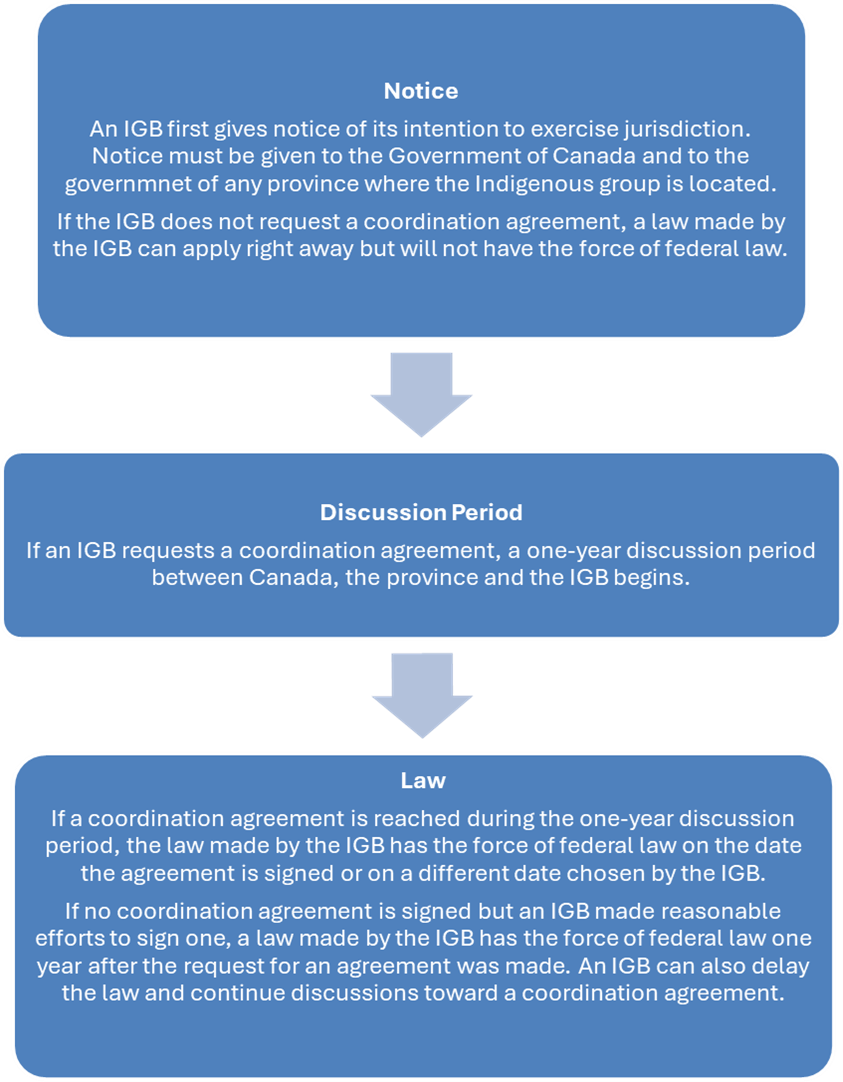
Once an IGB law has the force of federal law, it applies in priority to provincial law and most other federal laws in the case of any conflict. The Canadian Charter of Rights and Freedoms, the national standards set out in section 10 to 15 of the FNIM Act and the Canadian Human Rights Act continue to have priority. If there is a conflict with any other part of a federal Act or regulation or with any provincial law, the IGB law takes priority and will be followed.
In Saskatchewan, different Indigenous governing bodies are at different stages in this process and you should contact your First Nation or Métis Nation-Saskatchewan to find out what's going on in your community.
Click on the links below to learn about two examples of Indigenous jurisdiction in Saskatchewan.